New Button Battery Technology Shows Promise, but Swallowing Remains an Emergency
PR Newswire
ALEXANDRIA, Va., June 23, 2026
First-of-its-kind study finds protective battery technology can substantially reduce injury when ingested by children
ALEXANDRIA, Va., June 23, 2026 /PRNewswire/ -- A recently released child-safety battery designed to reduce the danger of accidental ingestion is showing significant promise, but medical professionals should not alter their management protocols yet.

In the first peer-reviewed scientific assessment of the recently commercialized Energizer Ultimate Child Shield™, researchers found that the titanium-based lithium coin-cell battery designed to protect the esophagus can reduce the severity of tissue injury. The study, published in OTO Open, the open-access journal of the American Academy of Otolaryngology–Head and Neck Surgery (AAO-HNS) Foundation, was led by Kris Jatana, MD, of Nationwide Children's Hospital and The Ohio State University.
The AAO-HNS urges families to keep all coin-cell and button batteries out of children's reach, secure battery compartments, and seek emergency care immediately if a battery ingestion is suspected. The Academy also calls on battery manufacturers to adopt technology that meets or exceeds the new safety standard for preventing severe injury inside the body.
Why Swallowed Batteries Remain Dangerous
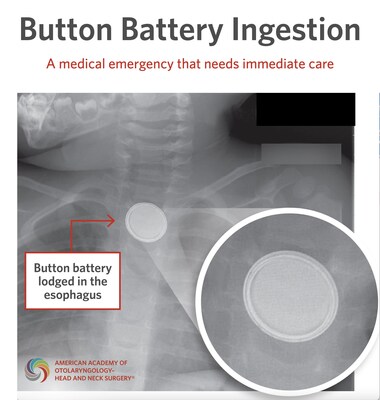
Lithium coin-cell batteries—also known to many as button batteries—are found in countless household products, including remote controls, key fobs, toys, holiday decorations, candles, and musical greeting cards. When accidentally swallowed and lodged in the esophagus, they generate an alkaline caustic burn that can cause severe tissue destruction in as little as two hours.
Every 75 minutes, a child in the United States presents to an emergency department with a battery-related complaint—a rate that more than doubled over the past decade. The National Capital Poison Center has documented 280 severe esophageal or airway injuries and 71 fatalities related to button or coin-cell battery ingestion.
"Far too many children have experienced life-altering or life-threatening injuries due to accidental ingestions in the home. With esophageal-protective batteries now commercially available, we expect to see meaningful improvements in patient outcomes," said Dr. Jatana, an AAO-HNS member, surgical director of clinical outcomes and professor of otolaryngology–head and neck surgery at Nationwide Children's Hospital and The Ohio State University. He has been a globally recognized expert in this field for more than 15 years.
Building Evidence for Safer Battery Design
The study also calls for additional research, including closer examination of injured tissue and the collection of real-world patient outcomes. Medical professionals can help by reporting relevant cases through smartphone-based registries, such as the Global Injury Research Collaborative's (GIRC) App for iOS. "All medical professionals who manage foreign body ingestion or aspiration events can easily contribute to a larger body of injury data to help drive change," said study co-author Keith Rhoades, executive director of GIRC, a nonprofit organization.
Manufacturers of electronic products can help protect children by consistently using the most advanced battery technologies available, said Rahul K. Shah, MD, MBA, a practicing pediatric otolaryngologist and chief executive officer of AAO-HNS, the world's leading medical society for ear, nose, and throat doctors.
"This is smart safety innovation with real potential to spare children from serious harm," Dr. Shah said. "That is worth celebrating, even as we keep treating every swallowed battery like the emergency it is."
Study Citation: Jatana, K.R., Rhoades, K., Litovitz, T., Moore, J., Cadotte, A.A., Mueller, J., Dytso, M., and Jacobs, I.N. (2026). Evaluation of an Esophageal-Protective Lithium Coin-Cell Battery within Current Management Paradigms. OTO Open. DOI: 10.1002/oto2.70266
About OTO Open
OTO Open is the official open-access journal of the American Academy of Otolaryngology–Head and Neck Surgery Foundation. Its mission is to publish clinically relevant, contemporary, and ethical research in otolaryngology–head and neck surgery that advances patient care and supports the global medical community through free and unrestricted access to peer-reviewed science.
About the AAO-HNS
The American Academy of Otolaryngology–Head and Neck Surgery is one of the world's largest organizations representing specialists who treat the ears, nose, throat, and related structures of the head and neck. Otolaryngologist-head and neck surgeons diagnose and treat medical disorders that are among the most common affecting patients of all ages in the United States and around the world. The Academy has approximately 13,000 members. Its Foundation works to advance the art, science, and ethical practice of otolaryngology-head and neck surgery through education, research, and quality measurement.
 View original content to download multimedia:https://www.prnewswire.com/news-releases/new-button-battery-technology-shows-promise-but-swallowing-remains-an-emergency-302807791.html
SOURCE The American Academy of Otolaryngology