World's busiest airports revealed in latest global rankings
PR Newswire
MONTREAL, April 14, 2026
Atlanta retains top spot for total passengers while Chicago O'Hare leads global rankings for aircraft movements
MONTREAL, April 14, 2026 /PRNewswire/ - Airports Council International (ACI) World today reveals the 2025 rankings of the world's busiest airports, highlighting the industry's leading hubs across total passengers, international passengers, air cargo, and aircraft movements. These airports play a critical role in the global air transport system, anchoring connectivity and enabling the efficient movement of people and goods worldwide.
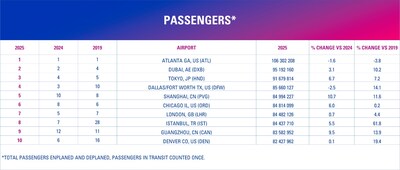
Hartsfield-Jackson Atlanta International Airport remains the world's busiest airport for passenger traffic, followed by Dubai International Airport and Tokyo Haneda Airport. At the same time, Chicago O'Hare International Airport ranks first for aircraft movements.
ACI World Director General Justin Erbacci said: "We congratulate the world's busiest airports for managing growing air travel demand amid increasing operational complexity. These hubs keep people and goods moving, supporting global trade, tourism, and economic growth in their communities and regions. To help keep pace with rising demand, governments must prioritize sustained investment in airports and the broader aviation ecosystem."
Total passengers highlights
- In 2025, global total passengers are estimated to have reached 9.8 billion, representing an increase of 3.6% from 2024 or a gain of 7.3% from 2019 results.
- The top 10 busiest airports for total passenger traffic represent 9% of global passenger traffic.
- Hartsfield-Jackson Atlanta remains 1st with 106.3 million passengers.
- Dubai remains 2nd with 95.2 million passengers.
- Tokyo Haneda rises to 3rd with 91.7 million passengers.
- Asia-Pacific airports are rebounding strongly, driving changes in global airport rankings.
- Shanghai Pudong records the biggest jump in the top 10, rising from 10th to 5th.This growth was supported by international traffic recovery, visa policy easing, and expanded connectivity.
- Guangzhou Baiyun rebounds to 9th position, up from 57th in 2022.
- 4 airports in the top 10 are in the United States, reflecting continued market strength. They all have significant domestic passenger shares (80–95% domestic traffic).
Global aviation context in 2025
- Resilient but fragile global economy: Global GDP grew ~3.0–3.2% in 2025, above expectations but below historical norms, with ongoing risks from trade tensions, protectionism, and policy uncertainty affecting air travel demand.
- Lower fuel prices and easing inflation supported demand: Jet fuel prices fell (~-13% YoY) and inflation eased, boosting purchasing power and sustaining strong passenger demand despite volatility.
- Global recovery led by international traffic: Global airport traffic rose 3.6% in 2025, driven by international demand and Asia-Pacific recovery, while North American and European hubs neared saturation.
- Capacity becoming a key constraint: Growth was increasingly limited by infrastructure and slot constraints in some regions, aircraft delivery backlogs, and air navigation limitations.
- Geopolitics reshaping traffic flows: Airspace closures and conflicts increased flight times and costs, prompting rerouting and shifting traffic toward alternative hubs.
- China's reopening boosting global hubs: The return of Chinese travel accelerated growth across Asia-Pacific and major hubs, strengthening global connectivity.
- Cargo trends and supply chain shifts: Air cargo volumes stabilized near record levels, supported by e-commerce and faster, restructured global supply chains.
International passengers
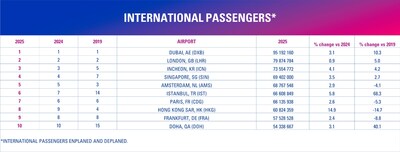
- International passenger traffic reached 4.0 billion in 2025, representing a gain of 5.9% vs 2024 and 8.3% vs 2019.
- The top 10 busiest airports for international passenger traffic represent 17% of total international traffic.
- Dubai remains 1st, while London Heathrow and Incheon hold onto 2nd and 3rd respectively.
Air cargo
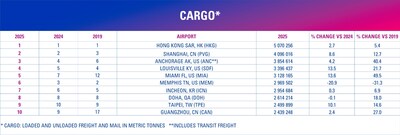
- Air cargo volumes are estimated to have increased by 2.9% year-over-year (almost +8.8% versus 2019), to almost 128.9 million metric tonnes in 2025.
- Air cargo traffic is more concentrated amongst the main airports. Air cargo volumes in the top 10 airports represent close to 26% of global air cargo traffic.
- The increase is driven by strong e-commerce demand and supply chain adjustments.
- Hong Kong and Shanghai Pudong remain in 1st and 2nd rank respectively, and Anchorage gains 3rd rank.
Aircraft movements
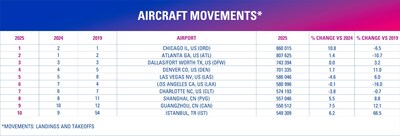
- Global aircraft movements are estimated to be around 101.5 million in 2025, representing a gain of 2.3% from 2024 results or +0.2% vs 2019.
- The top 10 airports for aircraft movement represent 6.4% of global aircraft movements.
- Chicago O'Hare ranks 1st, followed by Atlanta, and Dallas/Fort Worth.
About ACI
Airports Council International (ACI), the trade association of the world's airports, is a federated organization comprising ACI World, ACI Africa, ACI Asia-Pacific & Middle East, ACI EUROPE, ACI Latin America and the Caribbean and ACI North America. In representing the best interests of airports during key phases of policy development, ACI makes a significant contribution toward ensuring a global air transport system that is safe, secure, efficient, and environmentally sustainable. As of January 2026, ACI serves 811 members, operating over 2,200 airports in more than 160 countries worldwide.
Editor notes
1. The busiest airport rankings provide an exclusive first look of global air traffic. Initial data may differ slightly when the full rankings are confirmed in July 2026, which are based on detailed information from over 2,700 airports worldwide. ACI World's extensive dataset ensures the highest accuracy and reliability in airport travel demand rankings.
 View original content to download multimedia:https://www.prnewswire.com/news-releases/worlds-busiest-airports-revealed-in-latest-global-rankings-302740766.html
SOURCE Airports Council International (ACI)